
I’d been reading two books in parallel and, unusually, I felt I was getting an education; new information about things I really didn’t know much more than general knowledge previously. That was before I was rudely interrupted by my Stroke of Luck, so that reading and this post, started three weeks ago, and strictly remains incomplete even as I publish today.
I’m often pointing out #NothingNewUnderTheSun in that pretty much everything I’m reading really just confirms stuff that I’ve already abstracted from previous reading and life-experience, and that any “surprising truths” in the marketing of newer ideas and reading turn out to be ancient wisdoms restated - footnotes to Plato as some wag put it. Anything that needs saying has been written repeatedly many times, long before. I feel that anything I’m writing myself is simply stitching back together stuff that was already known, and has simply been forgotten, misunderstood, dismissed or misguidedly debunked in the “marketplace of ideas”.
It’s that particular marketplace that is my main research and writing focus. Memetics (or Mimetics), and more particularly #Dysmemics, whereby falsehoods and half-truths beat subtle and nuanced enlightenment with attention-grabbing short-form slogans. “Footnotes to Plato” is an example. Science itself too, perversely. ‘Twas ever thus, it’s simply turbocharged by electronic-media these days, making it almost impossible for mere humans - the nature and pace of our understanding - to resist or properly digest in practice. So, say, unregulated capitalist markets may assure that technology advances towards reducing its dependency on labour but with the techbros electronic turbodrive, inevitably shittier shit simply happens inexorably faster. Which isn’t to say “AI” (or whatever we’re calling the latest fashion this week) couldn’t be a force for good, just that the natural drive of dysmemics towards the lowest common denominators of received wisdom is reinforced and accelerated. They’re algorithmically learning from that very received wisdom we’d documented to date.
So, those educational books.
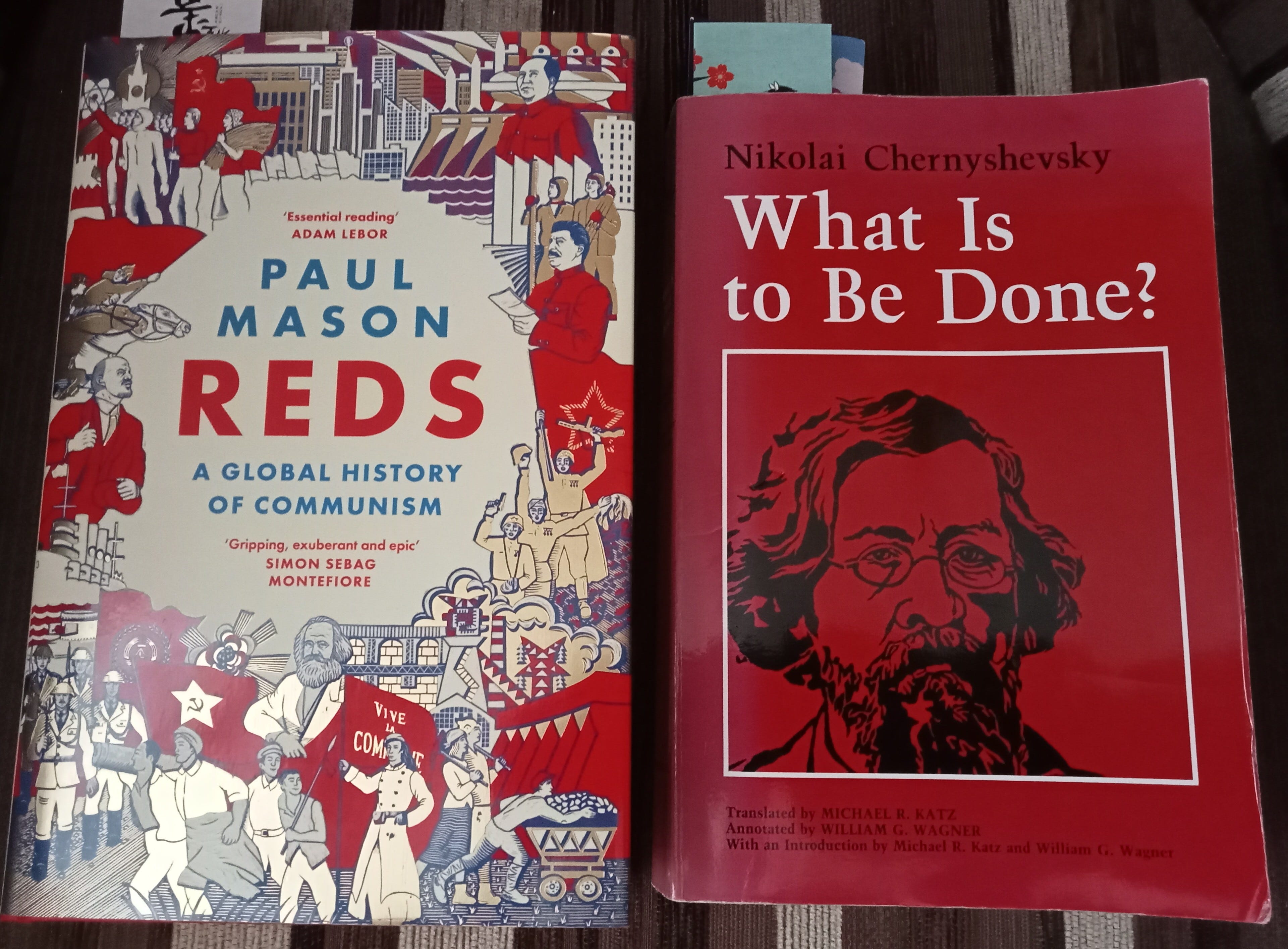
I mentioned in my previous post that I had accidentally started reading Paul Mason’s “Reds - A Global History of Communism”. The “Communist” meme has become the insult of choice of the Trump / Musk / Thiel / Farage axis (*) against anyone expressing the slightest hint of liberal-left social concerns in their politics, however mixed-economy cooperative-social-democrat their actual positions. Even the left has generally consigned communism to that pile of failed-in-practice social experiments. Long before I was a student of philosophy, I’d never been an active supporter of lefty “student” politics anyway. Marx nevertheless consistently tops polls of most-influential philosophers. If nothing else, his critique of capitalism left to its own devices is considered to remain valid even if applied communism itself must be considered a failure. As I’ve opined previously, even so, once we’ve escaped the Trump / Netanyahu / Putin / Russia / Ukraine farrago, we might want to understand where our world is headed hereafter with China? So let’s read “Reds”. What did the original communist ideas intend and where did they go wrong? How much were the ideas themselves doomed to fail and how much were they failed by bad executions, bad intentions or bad circumstances. Worth understanding?
We know all the words. Monarchy, aristocracy, elite, intelligentsia, bourgeoisie, proletariat, plebian, serf, labour, population, suffrage, commune, cooperative, International, Menshevik, Bolshevik, Comintern, etc … but what did they originally mean and how did they arise? Lots of words with overlapping meanings in English translated from their French, German and Russian-speaking origins, as well as earlier ancient Greek and Latin.
How long have you got? Mason’s book is 500+ pages.
The first thing to understand is that it doesn’t start with Marx and Engels, with (1867) “Capital” and the (1848) “Communist Manifesto”, even they went through multiple drafts, pre-cursors and updates anyway. Between the two, Marx’s (1857) “Grundrisse” even recognised the power shift towards a knowledge economy. Between labour and capital, knowledge is inherited social capital. The age of intellectual revolution had been happening in Berlin, Vienna, Paris and London before St. Petersburg. But, keep in mind Plato and his Republic and all those footnotes?
Long story short. Believing “we can do better as a society” has been the sensible concern of thinkers and politicians since time immemorial. Utopian thinking has always been part of that, both in the literally impossible, satirical “no place” sense, and in the idealised “what if?” thought-experiment sense and, in general, a bit of both. Not to mention the satirically opposite “Dystopian” genre - same subject, different angle and see also Eutopia and Protopia. It’s a natural pragmatic question. Assuming we could do it, what would be the ideal / best / better way to organise “our” society for the better? That in itself involves many (!) variables, practical & cultural, history & memory, incentives & motivations, influences & controls, not to mention human nature and values over short & long terms - life, the universe and everything.
Even with (say) universal suffrage for truly “general” elections - ie some form of democracy - the long-term stable situation must involve various hierarchical “elites”, different sub-groups of the population temporarily dedicated to different delegated and federated roles, trusted for day to day decisions and actions, selected on some basis. Assuming you could arrive at such a scheme for the “what” the best arrangement might be, probably involving many parts and alternatives, with some logical credibility and consensus, the next question is inescapable. How? How to get there from here? As ever, it would be so much easier if we didn’t have to start from here and now with all its historical baggage and messy detail - hence Utopian fiction.
Even a first step of agreeing (some aspects of) that future state, would involve winners and losers relative to the status quo. Even with a majority consensus on those first steps towards a longer evolution, there would be legal regulation (physical enforcement) of those first steps. And without such consensus such a first step is, one way or another, to a greater or lesser extent, violent revolution, coercion of a majority by a minority.
And here’s the rub. In the immediate aftermath of that first/next step, in addition to the intended long-term governance arrangements, we’re going to need interim - dictatorial / benevolent-authoritarian - arrangements, both to manage the reactionary backlash(es) and to cultivate and maintain long enough, conditions needed for ongoing evolution towards (important aspects of) the end-state. There can be no sufficiently detailed “plan” with levers we can pull with the necessary reach and timeframes, to “make it happen”. It’s complicated.
Even with a strong consensus on a desirable end-state, there are a myriad of tactical and strategic interim process and organisation possibilities to disagree about. At this level of abstraction, I still have the sense of nothing new being learned - that old evolution<>revolution tension - but Mason’s book documents in some detail the people and actions that really went through versions of these processes. (We’re in complex adaptive systems (cybernetics) space, and we’ve crossed paths here with Paul Mason’s work before, with the erstwhile Bolshevik colleague of Lenin, Aleksander Bogdanov - primarily via Mike Jackson at Hull University - and Mason’s (2015) “PostCapitalism”). If nothing else we learn that the thinkers of the age of revolution did actually put a lot of thought and planning into the transitions between revolutionary thinking & revolutionary action, and longer-term evolutionary progress to dynamically stable future states. Even without naming the beast, they were dealing with complex self-adaptive systems of governance - cybernetics. Mason’s “Reds” is a recommended read.
The second book? In terms of practical utopian thinking, the work that most influenced the long-lived Soviet implementation of Communism through revolutionary false-starts, via Russian culture and society around it, was Nikolai Chernyshevsky’s (1863) “What is to be Done?”
(Lo and behold, Mason’s reference, confirming its importance, is one of those I inherited from my mother’s U3A “Russian Literature” collection. So I’m reading that in parallel too.) From the (1989) introduction by William Wagner and translator Michael Katz:
“[These disagreements about how] helped precipitate a fundamental split in the intelligentsia between advocates of evolutionary reform and those who believed that fundamental change could be achieved only by revolutionary means. In these conflicts [Chernyshevsky] played a central role in both popularising materialist, positivist and rational utilitarian ideas among the intelligentsia and persuading many of its younger members that radical action was possible as well as necessary".”
And from Joseph Frank in The Southern Review (in full from the cover blurb):
“If one were to ask for the title of the nineteenth-century Russian novel that has had the greatest influence on Russian society, it is likely that a non-Russian would choose among the books of the mighty triumvirate - Turgenev, Tolstoy or Dostoevsky. Fathers and Sons? War and Peace? Crime and Punishment? … No, the novel that can claim this honour with most justice is N. G. Chernyshevsky’s What is to be Done? … No work in modern literature, with the possible exception of Uncle Tom’s Cabin, can compete … in its effect on human lives and its power to make history. For Chernyshevsly’s novel, far more than Marx’s Kapital, supplied the emotional dynamic that eventually went to make The Russian Revolution.”
And I’m now into the fictional narrative around “the feminist heroine” Vera Pavlovna who creates a “co-operative enterprise” from scratch, and “the extraordinary rigorist” Rakmetov (nick-named after Russian folk-legend Nikitushka Lomov). I may be some time.
For now, given my wider #MoreThanScience agenda, one of the important recurring considerations is where enlightened modernism went wrong - the logical positivism idea of objective science being the guiding principle for society’s arrangements - even suggesting history itself might succumb to predictable processes and laws. In the 21st century even the statistical or heuristic, causal unpredictability of history before it happens became non-ergodicity. With ergodicity and informational thermodynamics, science sets its own limit to predictability, a limit more limiting than mere statistical uncertainties, a limit to the most scientific application of statistical thermodynamics.
Of historical significance after WW1, when the successful Russian revolution to Marxist / Leninist communism had only just begun (after several unsuccessful pre-cursors), the 1920’s and 30’s saw the Vienna Circle (aka Mach Society) adopt logical positivism, and Koestler (as well as other Western intellectuals) first saw communism as a better option than liberal-social-democracy in the face of the rise of totalitarian Nazism alternatives. Then, after WW2 repeated the “never again” global crisis, the (1946+) Macy Conferences went round the “let’s design a better way” soul-searching thought processes again - and gave us Cybernetics.
It turns out Chernyshevsky’s What is to be Done? is a complicated piece of work as well as having the the full scope and complexity of the human organisation of humanity on planet earth as its subject matter, and a revolutionary plan to achieve it. Life, the Universe and Everything in my adopted short-hand. Let’s start with the structure of the work, chapters and numbered sections, some also with sub-titles, some half-pages, some many tens of pages:
=====
The structure:
Front & End Matter by Michael Katz (translation) & William Wagner (annotation)
Acknowledgements & Translator’s Note
Introduction: Chernyshevsky and the Russian Intelligentsia (36pp)
Principal Characters & Selected Bibliography
What Is to Be Done? by Nikolai Chernyshevsky
i. The Fool
ii. The First Consequence of This Foolish Affair
Preface
1 Vera Pavlovna’s Life with Her Family
(i, ii, iii, iv, v, vi, vii, viii, ix)
2 First Love and Legal Marriage
i, ii, iii, iv, v, vi, vii,
viii Hamlet’s Trial
ix, x, xi
xii Verochka’s (Vera Pavlovna) First Dream
xiii, xiv, xv, xvi, xvii, xviii, xix, xx, xxi, xxii, xxiii,
xxiv Eulogy of Marya Aleksevna
3 Marriage and Second Love
i, ii,
iii Verochka’s (Vera Pavlovna) Second Dream
iv, v, vi, vii, viii, ix, x, xi, xii, xiii,
xiv Kyukova’s Story
xv, xvi, xvii, xviii,
xix Verochka’s (Vera Pavlovna) Third Dream
xx, xxi,
xxii Theoretical Conversation
xxiii, xxiv, xxv, xxvi, xxvii, xxviii
xxix An Extraordinary Man
xxx,
xxxi A Conversation with the Perspicacious Reader Followed by His Expulsion
4 Second Marriage
i Berlin, July 20, 1856 (Letters)
ii Petersburg, August 25, 1856 (Letters)
iii, iv, v, vi, vii, viii, ix, x, xi, xii,
xiii A Digression on Bluestockings
xiv, xv,
xvi Verochka’s (Vera Pavlovna) Fourth Dream
1, 2, 3, 4, 5, 6,
7 [*** Self Censored ***] (The call to revolution hidden from Tsarists.)
8, 9, 10, 11,
xvii,
xviii A Letter from Katerina Vasilievna Polozova, St Petersburg August 17, 1860
5 New Characters and the Conclusion
i, ii, iii, iv, v, vi, vii, viii, ix, x, xi, xii, xiii, xiv, xv, xvi, xvii, xviii, xix, xx, xxi, xxii, xxiii
6 Change of Scene
=====
All I can do here on a single read is express some impressions, each of which will require deeper readings.
Given the focus of my agenda above, I’m sceptical that the main intended message was “popularising materialist, positivist and rational utilitarian ideas” as suggested by Wagner & Katz. (In fact this may itself be an example of dysmemics?) Lots of such ideas are expressed from referenced resources as part of the (auto-)fictional dialogues, but in discussing them I don’t see any strong recommendation on their validity. They do of course fit the received wisdom of post-enlightenment modernism, so they naturally “stick” as ideas, intended or otherwise.
Mostly we only know the source ideas from the footnote interpretations added by Wagner & Katz, but unsurprisingly, many are the same names used by Mason in Reds.
The language has the feel of Russian classic literature, Pushkin allusions as well as the “triumvirate” referenced, and very much the mixture of patronymic and multiple familiar / diminutive nick-naming of the characters, making that Principal Characters (p37) essential for English readers.
The main impression is a man putting words into the mouth of his feminist (cooperative) heroine, and a great deal of dialogue and monologue about what men and women understand about each other (and other national cultures). Fascinating in itself.
“Surprisingly, its dominant preoccupation is neither politics nor economics but the emancipation of women. its main character a feminist (and a very engaging one). The book is analytical, didactic, talky and long-winded; it is also witty and psychologically sharp.” Lucy Despard, Foreign Affairs.
My impression completely agrees with that. I’m wondering if Wagner & Katz picked-up only the explicit ideas and missed that psychological wit. We need to remember Chernyshevsky was already two years in prison for his ideas, whilst writing his book. Plausible deniability might require a few word games? (Another reason AI is a real danger when dealing with what is mostly rhetoric). And, the two chapters before the preface. What’s that about, a book within a book?
Feels like a whole research project in its own right. Pity I didn’t pay any attention to this work at the time my mother was reading it with her U3A Russian Literature group?
====
Enough! The rest of the “dear diary” entry - more reading and gigs - I’ll continue over at the original blog and then get back to the serious research writing :-)
(*) For fun watch these MAGA’s talking about “communism”:
====