Penrose-Hameroff Consciousness
Does their work actually give us any explanation?

This post elaborates my note from a week or so ago on Roger Penrose’ work, following further X/Twitter dialogue during the week with Stuart Hameroff (and others) on their claims about quantum effects and consciousness.
Having followed Hameroff from afar since the earliest Tucson, University of Arizona “Science of Consciousness” and “Quantum Mind” days, 2004 in my case, and many other scientists and philosophers of consciousness who arrived on the public stage via that route, I have maximum respect for his experience and expertise as an anaesthesiologist. Who else could have more direct empirical person-to-person knowledge of levels and aspects of consciousness in humans?
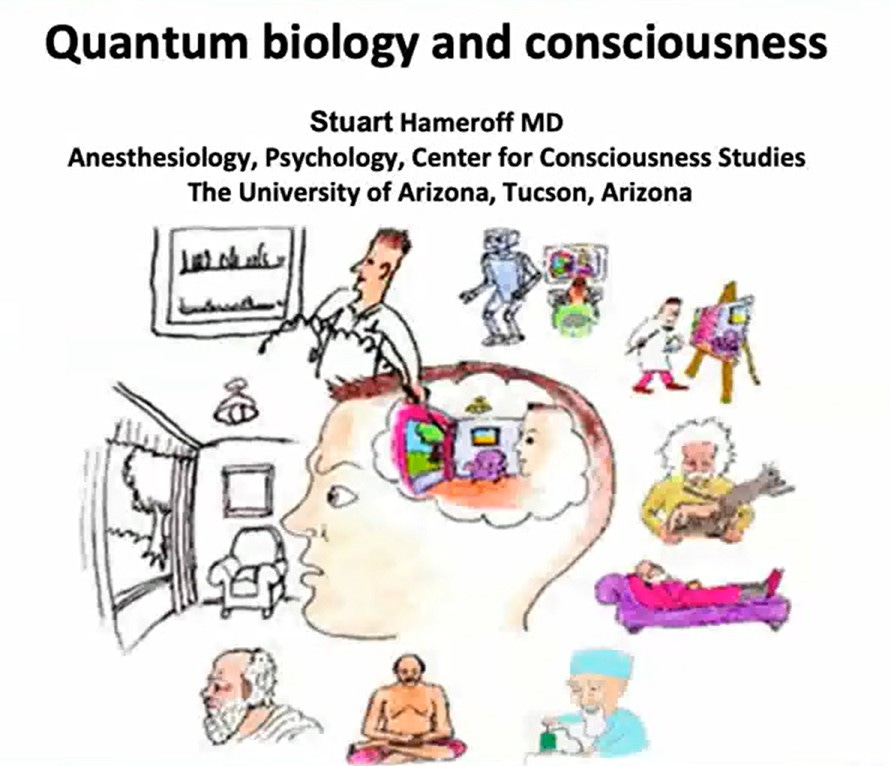
And he’s clearly taken that interest into his neuro-scientific and psychological research. Too many people have views of multi-layered / multi-aspect consciousness as a monolithic phenomenon and too many have what Hameroff calls a “cartoon neuron” view of the neuroscience in terms of simple on-off-firing devices. His “microtubules”-enabled Orch-OR science is almost certainly good science, proven even. It explains quantum mechanical effects at the scale of biological cells, including neurons and other brain and nervous system cells. (In the UK people like Jim Al-Khalili and Johnjoe McFadden have taken these quantum biology effects into explanations of other biological processes like photosynthesis and more.)
In these dialogues, I’ve been asking for a succinct statement of their claims as to why and how this “explains” consciousness and/or how it “solves the hard problem” of consciousness. Apart from challenges like “does anyone have a better (more scientifically tested / testable) theory?” that provides an explanation, there has been no statement of the Penrose-Hameroff position forthcoming.
So I asked ChatGPT again, given all the stuff I’ve read and written recently and over 25 years, what am I missing? Not much it seems.
As I already noted in last week’s note, Penrose was already using his a priori mathematical-physics position to explain minds and, thanks to the Gödelian limitations on computability, he was looking for a missing physics level explanation using quantum uncertainty to open possibilities for conscious will beyond algorithmic determinism. With ChatGPT’s help as I say, I’m guessing that Hameroff’s Orch-OR/Microtubules are a response to Penrose’ search for that non-computable physical opening - despite Penrose warning against conflating computability and determinism?
My Virgil, my guide in Gödelian space, was Doug Hofstadter, not Roger Penrose. So, in my case, the response to the Gödelian fact that mathematically-computable-physical-science can’t explain everything - "There are more things in heaven and earth, Horatio, than are dreamt of in your philosophy …” - is that, even though information is still being processed, the break with algorithmic mathematical computability, arises in emergence and two-way causal synergies between multiple layers of complex systems of reality. New layers are supervenient on existing layers, but their contents not causally determined by them. The term most commonly used now for this evolutionary historicity is non-ergodic. Though I’ve noticed older references since, it was 2017 before I added ergodicity to my vocabulary, and even though evolution of complex adaptive systems through patterns of information processing - Cybernetics / Psybernetics - has been my thread since 2001. (And as noted previously, whilst Penrose uses many of the same information<>entropy cosmic-evolution arguments, he dismisses Darwinian evolution as a second-tier “non-superb” scientific theory and doesn’t make use of ergodicity concepts by name.)
So Microtubular-OrchOR may open fundamental physics to the possibilities of quantum uncertainties at otherwise wet, noisy, biological levels, it still doesn’t seem to explain wilful-subjective-consciousness, nor does it seem necessary that it does, given perfectly good complex systems explanations.
That challenging question - name one? Several, like life, the universe and everything generally, are supervenient on others, evolved over historical time, but right now I’d say Mark Solms interpretations of Karl Friston Active-Inference / FEP stands proud on the shoulders of their giant predecessors. Explains how will-ful consciousness arises and our subjective experience of it, not merely the possibility that physics is open to it.
The challenge to that answer. How scientifically “proven” is that theory? It can only ever be proven in part by repeatable empirical testing. In some cases the heuristics of the social and political sciences may shed some scientific light on the subjective processes, but never repeatably at any detailed level. With supervenience and synergistic emergence, rather than determinist causation, the specifics can never be predicted repeatably, not even statistically. Only aspects of the topology - the generality of shape and organisation - of outcomes are predictable qualitatively. The so-called hard-problem - our subjectivity - is by definition, by design, excluded from this kind of objective scientific explanation and experiment. As Solms puts it, we need to cross the Rubicon, to welcome subjectivity into our otherwise scientific venture.
#MoreThanScience - (More than the kind of science that is repeatably, objectively, empirically verifiable. “Science is 20:20 hindsight” and that’s not good enough for decisions whose outcomes evolve on human timescales. We can learn from history, but not predict the specifics of it. Evolution may not be a “superb” theory in Penrose mathematical-physics terms - it can certainly never give us empirically repeatable predictability, but it’s (a) real, (b) non-computable. We don’t need to know every detail in order to explain subjective consciousness. Fortunately.)
=====