
I keep coming across earlier writings (bloggings) of mine where it’s clear I could have written the book(s) I’m trying to write now 20-odd years ago.
My old posts still get lots of hits, probably Google (and now LLM-AI) search hits, so no guarantee any eyeballs or minds ever follow-up the hits. Today I followed-up a hit on this “Psychology as Philosophy ?” post from 2006. It’s a partial review of my reading of Daniel Wegner’s (2002) “The Illusion of Conscious Will”.
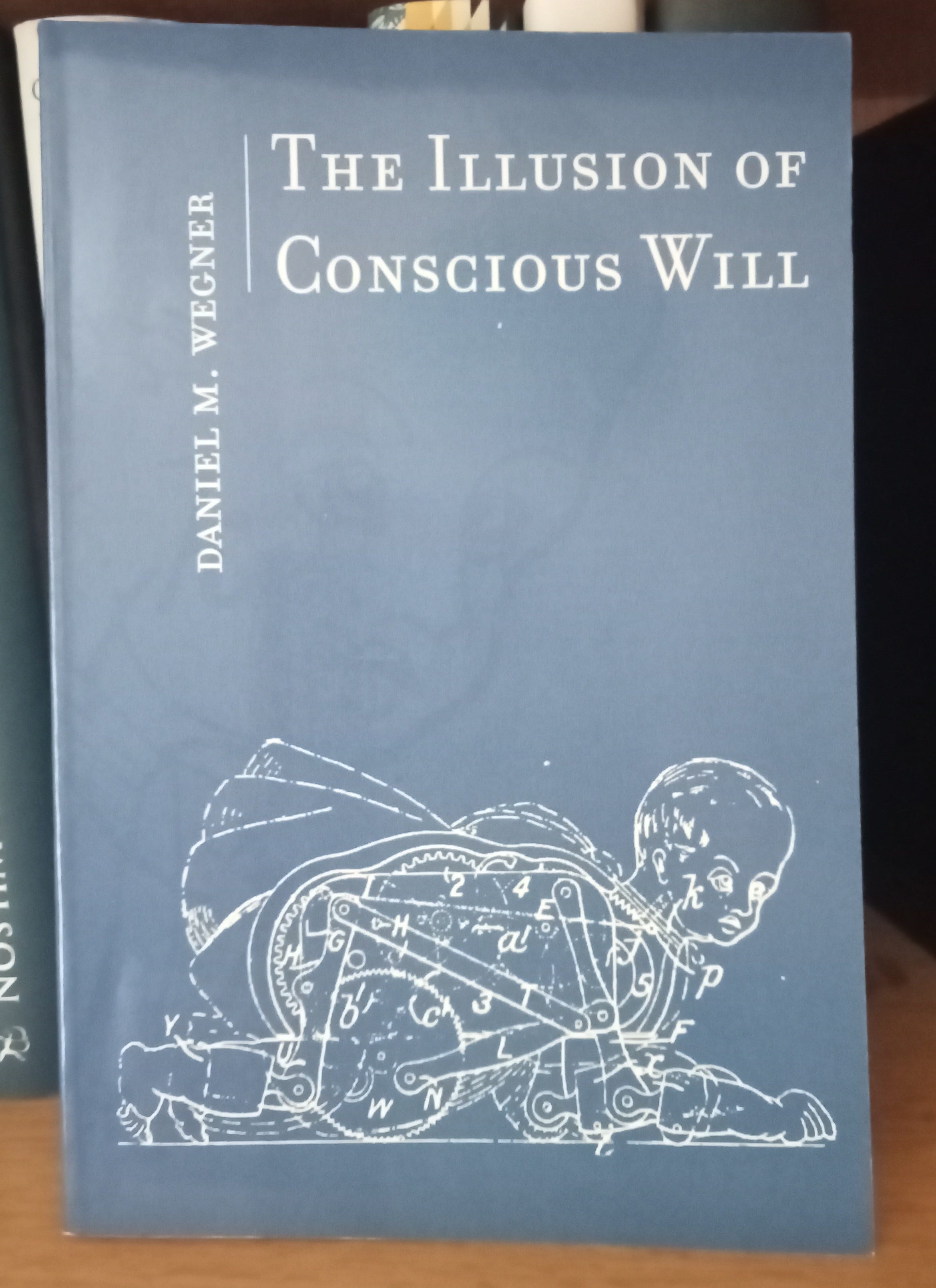
As with the “illusionism” of Dan Dennett and Keith Frankish - and the “hallucination” of Anil Seth - I was already concluding back then, that the illusion is in how we imagine our conscious will manifests itself, NOT a suggestion that consciousness and free-will are themselves illusions. They are real phenomena. And neither is black and white - consciousness is on a spectrum from comatose to high on adrenaline (and on several other variable dimensions) and will can never be total, ranging from helplessness (0%) to pulling hypothetical levers (100%) via all the levels of influence, chance and wishful thinking in between, not to mention the actual constraints of the laws of physics. (Incidentally as Freud, quoted by Karl Friston and Mark Solms, said “All thinking is wishful thinking”.)
Coincidentally, just yesterday IAI / HTLGI (of whom I’m a big fan) X/Tweeted a video of a George Ellis talk advertised as responding to the idea that “modern science has begun to treat free-will as a comforting illusion” to which my response was “modern science is therefore bollox”. We all, including George (and Mark Hammonds on the X/Twitter thread) know it’s real.
Part of the reason science struggles - whilst ignoring the 21st C work of Iain McGilchrist and Mark Solms (as well as Dan Dennett already mentioned) - is that logical-positivist, reductionist scientific logic is always looking for objectively repeatable cause and effect, if this then that explanatory theses. A cartoon version of cause and effect. Once we have the psychological human agent(s) in the loop(s) - or any other layers of system complexity - so many other possibilities are emergent. Loved this quote from Wegner:
“[Attribution and post rationalisation of cause and effect are a shorthand …] people can get pretty bollixed-up in their understanding of who did what in a social interaction […] even with the computational tools of the average rocket scientist, it could be a sizable task to figure out who did what in just half an hour of facilitated interaction […] every possible thought-action combination […] Imagine what this would look like […] in the course of a few hours of court proceedings or the snappy repartee of a good romantic comedy.”
Psychological philosophy is become topical. No coincidence that Solms and Freud were neuroscientists before they were psychotherapists and that McGilchrist was a literary analyst and a psychotherapist before he was a neuroscientist. If science refuses to cross Mark Solms’ “Rubicon” from objectivity to subjectivity, or use both halves of McGilchrist’s brain, it’s going to remain a sad deluded backwater. Cartoon science. (Hat tip Stuart Hameroff for the “cartoon” inspiration.)
=====