A Welcome Diversion Around Dennett
Belated review of Dan Dennett's memoir "I've Been Thinking" (2023)

I’m in at least two minds whether to create this as an article or just a note, here or over at my www.psybertron.org WordPress blog. Still transitioning from there to here, but preserving the structural and content value over there. It’s unlikely to be the kind of quality, article or review intended here, but here we go, me joining up more dots as per usual.
After a few days of very productive writing (by my standards, anyway) I had to give some attention to distracting commitments to the Robert Pirsig Association, to the conversation started with Keith Gillette in the previous post here, and to plans for an event in July to promote interest in plans for 2028, Pirsig’s centennial.
Notwithstanding the philosophical - metaphysical as well as onto-epistemological - content of the dialogue with Keith, which has continued in that discussion forum - I was kinda knocked-out by the discovery of our shared interest in my hero, Dan Dennett. Pretty much all of Dennett’s writing is already internalised for me, even more than I could credit it turns out (below). After summarising my take on his work in response to his death in 2024, I’d not made any / many explicit readings or references since. But I was reminded by the Pirsig parallel below, that his memoir “I’ve Been Thinking” (2023), published inside the last year of his life, has sat (mostly) unread on the shelf behind me. So I was prompted to pick it up.
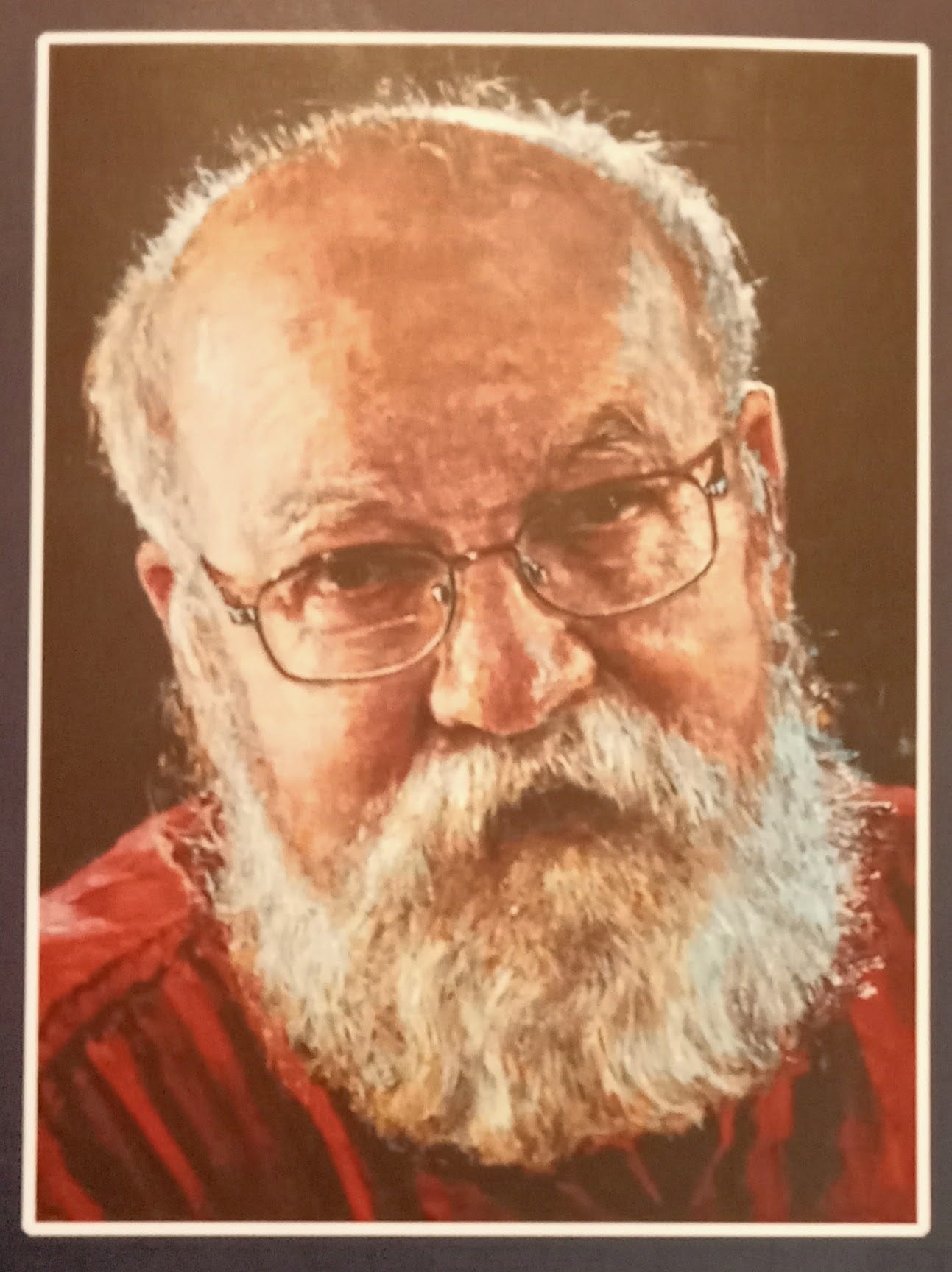
I’ve read the whole over about 4 days, furiously annotating with coloured stickies, including sections I had clearly read before(?) but had completely forgotten(!) - and having to break-off to follow-up references, mine and his. Approaching more notes than text again so, as ever, this will be too subjective to count as a review. And too disjointed because for several densely interesting sections I simply gave up annotating, which always results in more points of interest - to my writing agenda - than I am ever likely to find and join-up coherently again!
Before I pick-out a few specifics that interest me, two important highlights for any interested audience:
(1) In “I’ve Been Thinking” - Dan Dennett (2023) - he confirms, as I have done explicitly before, that he considered his “From Bacteria to Bach and Back” (B2BnB, 2017) to be his magnum opus - the place where he best summarises the important content of his life’s work - what he believes he has learned about Mind, Consciousness and Free-Will, but “stripped of extraneous argument and digression”. It’s all there. Recommended, as ever.
(2) “I’ve Been Thinking” - as a memoir - effectively summarises all the arguments along the way to that content. His journey from “Content and Consciousness” (1969) to B2BnB (2017) above via “Consciousness Explained” (1991). There’s no false modesty with Dan: where he believes his work is right and good, he says so, and even outside the philosophy day job, the farming, sailing, music, husbanding, neighbouring & parenting, he’s no different in that respect. It really is some life story. Being in the last year of his life, the gloves were off when it comes to the arguments that shaped his work. He generously names all the collaborative disagreements that became constructive criticisms from which he (and his students) learned, whether those criticisms were from his big name rivals in the consciousness game or from those students and newcomers. But he holds no punches when naming those he considered disingenuous closed-minded bullies along the way. Some of those “arguments” are themselves legendary topics of other philosophical writings and most of the positive (and negative) reference contributors I’ve followed-up and done my own reading before, but there were a few surprises, including some that shouldn’t have been:
Those unexpected gems for me:
Pirsig & Teaching Quality - I had completely forgotten, from my previous brief skim-reading, that there was a striking similarity between Pirsig and Dennett when it comes to teaching quality in writing. Dennett (in 1971) gave his students’ early drafts unexpectedly low grades, but set-up class discussions where they critiqued the quality of each other’s work, one example sentence at a time. Pirsig (in 1959) declined to give the grades his students had come to expect and he set-up similar mutual critiques in class, one sentence or one object (even a house-brick) at a time. Sure enough, in both cases, the learning was that they already knew good quality writing when they saw it and they thereby learned its importance. I’d forgotten despite the fact I actually wrote about it at the time!
Junkets as Social Settings for Good Work - fascinating how many meetings and conferences were set up as visits or cruises to exotic locations with institutional and benefactor funding for good food and good wine in good company. Again, some of the specific events, one-offs and recurring, are well known - the arctic cruise to which Philip Goff was invited early in his career springs to mind, and early TED Talks generally. When topics and arguments are complex, formal academic critique and response does actually depend on good faith motives in all parties (see disingenuous bullies above) and there are only so many hills you can choose to die on, only so many refutations worth your while. Life’s too short - as I already quoted Dan from B2BnB. The best way to cut the crap is head to head in congenial circumstances. (Like all games, the opposite can also be true. A flattering invitation can be an opportunity to load the room against you - see disingenuity again - hence the social beyond the formal. No progress without real interpersonal trust.)
John Brockman - As well as being open about the “junket” social nature of many trips and meetings, Dan is very open about acknowledging the contribution of John Brockman at The Edge being his publishing agent. Say - if you need to wait and count royalties you’ve not got the best deal from your publisher - who has effectively undersold the advance. Wealthy movers and shakers inviting public-intellectual big-names associated with the the top level academic institutions is obviously a game of power, influence and mutual credibility - a hand that Jeffrey Epstein played in spades to immoral excess. (There is no doubt Brockman and Epstein crossed paths in this game, but equally no guilt by association where there is honest intent, trust and openness. There is no mention of Epstein in Dan’s memoir.)
Jean-Pierre Dupuy - There is, in my words, “a ubiquity of systems thinking” in Dan’s work. What else is news? The word system is much used and even the word cybernetics occurs positively multiple times. What I hadn’t noticed - or had forgotten - is there is a very positive reference to Jean-Pierre Dupuy’s contribution to his thinking. Dupuy (1994) was a very important early resource for me, before I understood their significance, on the 1946 Macy Conferences from which Wiener’s Cybernetics (and a lot more) emerged, and on the significance of art and post-modernism (foggie-froggies) over and above (but not against or instead of) science and logic. It’s from where I coined my own Post-Post-Modernism (PoPoMo) and Psybernetics. And related, that stuff will always seem “foggie” to any would-be-precise-scientist, but as Dan frequently points out vagueness is good at some levels of abstraction if you want constructive progress in achieving understanding. (Note: I see that I first read Dupuy in 2002 about a month before I read any Dennett and that Dennett is a multiple reference in Dupuy.)
Illusionism and Keith Frankish - there are obviously a thousand other references to positive contributors along the way, especially the women - Ruth Millikan and Lynn Margulis to name but two (did I originally get that from Dan too? - another story). I knew Keith Frankish (colleague of Philip Goff) was one of those who promoted Dan’s “illusionism” in consciousness - “controlled hallucinations” to Anil Seth. I’ve always been defensive against the terms illusion and hallucination when I see them being misinterpreted as criticisms of Dennett somehow dismissing consciousness, and I am especially wary of “isms” anyway. Frankish actually gets multiple positive acknowledgements in Dan’s memoir. I’m going to have to follow-up Keith’s work, but for now my understanding is: It’s NOT that consciousness is merely an illusion or epiphenomenon. It clearly is a real phenomenon. The illusion is that there is some “user” experiencing the illusory / hallucinatory / imaginary / subjective / nebulous / emergent nature of consciousness. Dan’s point (and Mark Solms’ too) is that these (subjective) experiences are both our consciousness itself AND our self doing the experiencing of it. That’s all there is. That’s who ”we” are. There is no separate self or we, it is me. The illusion is the user - it’s a “user illusion”. Experience is the experiencing is the experiencer.
As indicated earlier Dan has no false modesty. Even his final chapter “What if I’m Wrong?” clearly points to the value in clearly documenting his and others’ errors along the way.
=====
Post Note: Just a couple of days before this post, a special edition of Imperfect Cognitions by Lisa Bortolotti featuring a round-up of Dennett’s work, including a contribution from Frankish.
Post Note: And, just yesterday, Galen Strawson republishing “Consciousness Isn’t a Mystery” from ten years ago - we agree - but pointedly NOT mentioning Dennett at all.
Post Note: And, I mentioned in a note yesterday being concerned about the well-being of Jessica Flack (ex-SFI). Having mentioned Sara Imari-Walker as one of her SFI collaborators, I was reminded I had her “Life As No-one Knows It” unread here. So I gave it a read. A bit “basic” for me, very little I hadn’t read or thought elsewhere already and nothing really to disagree with in terms of theories of life and intelligent will-ful consciousness. Dennett gets positive mention as part of her EES. And I’m already conflating two readings where I’ve not written reviews. As well as reading Imari-Walker, I recalled I had a kindle copy of Anil Seth’s “Being You”, being reminded of him because he was in the audience of Chalmers’ eulogy for Dennett, which I’d obviously just revisited. So I’ve just read that too. Although he uses the word hallucination the same way Dennett uses illusion, and lots of positive references to Dennett, I don’t really see Seth committing to any strong theory of consciousness. His is a good survey of many of my sources, EES and IIT as well all the usual suspects. Particularly positive about the difficult Karl Friston and FEP but Mark Solms relegated to just another available theory. No mention of SFI people. Unsurprisingly, given the FEP attraction, a very positive take on cybernetics, and a very welcome surprise his strong recommendation for Dupuy’s contribution. All good but little new under the sun.
More Post Note: After falling down the SFI rabbit hole, people and funding, the original “Cowan” campus and the new “Miller” campus both in Santa Fe, NM, I was browsing the collection of proceedings from their 1989 “Complexity, Entropy and the Physics of Information” conference compiled by Wojciech Zurek, with John Wheeler, Paul Davies, Murray Gell-Man, Jim Hartle, and Stuart Kaufmann. “Seminal” stuff, as they say, which I’ve had in hard copy since it was published in 2023. In 2026 David Krakauer is SFI President, and whaddya know, his blog is formatted Zettelkasten style, a collection of 3” x 5” cards or slips - visual formatting only sadly, not electronic semantic structure, but absolutely explicit.
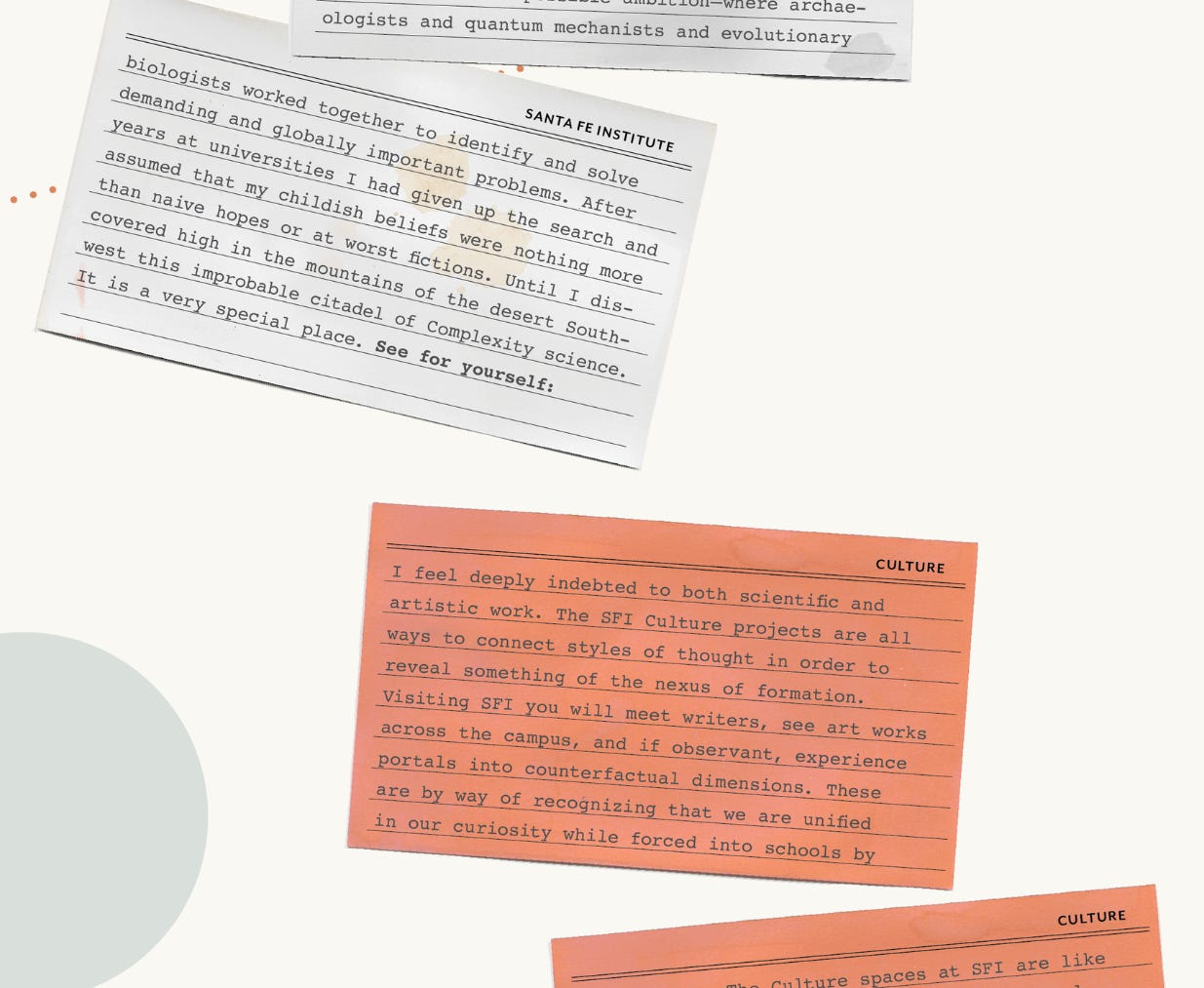
The plot thickens!
=====