Pirsig's 4 Layer Metaphysics
The Multi-Axis Evolutionary Layering of Values in "Onto-Epistemic Structures".

Preamble:
Keith Gillette is a fellow member of the Robert Pirsig Association (RPA) and over two decades ago we’d both been members of the MoQ-Discuss Forum, discussing Pirsig’s “Metaphysics of Quality” (MoQ) propounded in his rhetorical works ZMM(1974) & Lila(1991). Gillette is one of the acknowledged contributors to those discussions, summarised in Dan Glover’s “Lila’s Child” (2002) but I was a latecomer to that party, so our time barely overlapped in those MoQ-Discuss days. We had little direct knowledge of each other’s thinking until the RPA launched its (new) RPA-Forum on Discord this year, in spring 2026.
Pirsig’s MoQ is a metaphysical monism founded on the “Quality” of participation in the world, and a key feature is that Pirsig uses this to describe the world in evolutionary layers from the foundations of physics to the highest levels of human psyche. The real attraction of this approach is that it avoids any pre-emptive dualist division into the physical and the mental nor even into subjects and objects. Like everything else, these all emerge through evolution, Darwinian or otherwise. Whilst the Quality of immediate participation is always dynamic, those evolved layers are identifiable as static(*1) patterns of value in the progress of the cosmos. So, another corollary is that whilst the participation is always here and now, deep time is built into the layered evolutionary timeline from history into the future.
The Quality-based metaphysics may be specific to Pirsig, but in the post-Darwinian 20th century, there are multiple worldviews - ontologies and epistemologies - that recognise evolutionary layering, especially in the philosophically interesting areas of human understanding of ourselves and our engagement in the cosmic ecosystems we inhabit and influence.
Ontologies in the Time of AI
In 2026 it’s difficult to imagine any discussion of human knowledge and conscious intelligence that doesn’t at least acknowledge the appearance of LLM-AI’s impinging on every aspect of the environment around us, if not actually making it part of the subject of discussion.
One particular set of discussion threads was prompted by Gillette sharing this recent piece by Robb Smith of the Institute of Applied Metatheory (IAM) “Beyond Alignment: Alethic AI and a Real Values Topography”. Whether alignment is a strong enough word or not, it’s already part of a wider dialogue about how we avoid losing human values in any AI that presumes exclusively objectively capital-T “alethic” truth being represented by its language model. No ontology without epistemology I say, and indeed the claim in summary is for:
“Value Depth Ontology - the accumulated temporal onto-epistemic structure of natural complexity and human sense-making constitutes the value domain itself”
That quote, like the whole piece and its title, is pretty dense, technical-jargon-wise, but it nevertheless prompted quite a few discussion topics that take us into the ever-fertile social and intellectual layers of Pirsig’s 4-layer MoQ. Lots of food for thought and ongoing discussion there, not least on the significance of epistemologies to our deemed ontologies. And I suspect Smith’s use of Topology there is a hint that what matters is the general shape of organising our “onto-epistemic structure(s)” rather than the specific components and geometry we choose - arbitrarily - it’s “meta”. (Feel free to join the conversation there.)
One specific subject, the reason for my post here, is evolutionary layering of reality more generally where, although the IAM piece evokes Pirsig (to a Pirsigian) without any explicit reference, it does specifically draw on Ken Wilber’s 3 tiers of 12 levels of evolving consciousness. It’s a comparison Pirsigians have noted before as parallel to Pirsig’s 4 physical / biological / social / intellectual layers.
Remember that Gillette and I didn’t really have much prior knowledge of each others work or world-views, but in the course of just two exchanges we’d both mentioned our previous common influences of Dan Dennett(*2), Cybernetics(*3) and Valentin Turchin(*4). For the back-stories on those subjects, see the footnotes below. For now let’s continue with our topic of evolutionary layering of epistemological ontologies in general.
In that exchange, Gillette shared his mapping from 2021 of corresponding layers between Pirsig, Dennett and Turchin in addition to the Wilber layering in the original paper. So here we have 4 parallel evolutionary layering views already, several more in the evolution of Cybernetics itself (below) and as I already contended, many post-Darwinian ontologies that recognise layering over historical timescales. Rather than a beauty contest between different specific models, which is best etc, each will have their own reasons and contexts in which they were proposed, only a few of which were metaphysical, what I want to focus on first is even more abstract. The topological concept of evolutionary layering itself, when constructing any model, any epistemological ontology.
Evolutionary Layering
Whether we are talking of the evolution of the cosmos generally, intelligent life within that, the governance arrangements of civilisations and ecosystems generally or the emergence of specific structures in particular human projects (including that of human understanding of the whole), there is a primary historical time axis over which things change, effectively by definition.
Change is difference over time - we had that, now we have this - and apart from the elapsed time, the difference is between this and that. Such a distinction - the significant difference between this and that - seems clearly binary but there are two aspects to note. Firstly, however clear, deeming a particular change to be significant is itself an arbitrary choice. What is the significance to our purpose, some emergent significance amongst the gazillions of possible states of the particle population of the cosmos including minds in humanity. And, having drawn that dividing line as significant it was done for a reason - a “good fence” - where the reason has to be respected to have any value or meaning, whilst at the same time understanding that it can be moved / evolved as the significance and reason evolve. Secondly whilst this and/not that looks binary, a duality, there is actually a triple (or n-tuple) involved. We have those two things and the distinguishing feature(s) we’ve deemed significant.
Ontologies as part of semantic networks comprising directed node→edge→node triples isn’t a new idea(*5) when trying to build our models of reality. - significance basis of our dividing lines - dichotomies - the forks in our ontological web of taxonomic hierarchy (type, class etc), mereological (whole-part etc.) and indeed any other significant relationships, means our heterarchical ontological model has an epistemological basis: what we consider to be significant. Dichotomies are fundamental to taxonomies, and each implies a triple.
Whilst it remains easy to present time as the one (primary) axis, whether thinking in 2D or a 3D projection onto a 2D diagrammatic network or tabular view, what tends to get overlooked when picturing the evolving model is the multiplicity and complexity of the axes of those variable features - significant differences - beyond, or orthogonal to, the time axis. They get flattened into the one remaining axis in view.
So combining those last two thoughts. Whether thinking in node→edge→node or this→good-fence→that terms, everything comes in three layers, including each layer and their dichotomous good-fence dividing lines. Every thing resulting from one significant division can be subject to further division when an alternative significance arises. And, once you get beyond a single triple - one dividing line between two layers or the two boundaries of any one layer - successive divisions are not generally directed along the same axis unless we’re dealing with a simple one-dimensional domain. No interesting domain is that simple.
However many layers we divide our global domain into - they’re only “good-fences” after all - we can always find alternative reasons to sub-divide or alternatively-divide their significance. And, other than time in an evolutionary view, the axis we choose to present orthogonal to our layering doesn’t generally represent one continuous variable.
Pirsig’s choice of 4 layers is no different in this respect to any number of multi-layer time-ordered evolutionary views, 5, 7, 12 you name it. Pirsig’s “PBSI” 4 is about as natural as you can get looking at evolution of the entire human cosmos since the big bang, and 4 is about as simple as you can get adding the complexity of additional axes to the original simplistic one-dimensional 3. (Incidentally Systems Thinking has it’s own non-metaphysical candidate of 4 layers in “DSRP”(*7). It has a quite different primary axis to Pirsig’s PBSI, with DSRP being more concerned with system / problem / solution timelines than cosmic evolution, but nevertheless parallel and useful in its domain.)
I applied the above thinking to multi-dimensional evolutionary layering to Pirsig’s MoQ over two decades when I encountered the inconclusive debates that left us without clear understanding of his Social and Intellectual layers. The information patterns in the Physical and Biological layers were essentially “genetic” with their information patterns physically encoded, even if there were additional multiple dimensions and layers within the two highlighted. The Social and Intellectual layers were on the other hand more “memetic” with information encoded in - put simply - mental layers. So “SI” parallel but fundamentally different to the “PB” layers and “SI” infinitely more interesting (to humanity beyond the realm of scientific enterprise) and therefore more urgently in need of resolving and understanding the multi-dimensional axes with the two layers highlighted?
This was my first draft attempt at describing a view intended to resolve that issue:

This was my working model / mental image (in 2012) of Pirsig’s MoQ. It’s limited by being in 2D with evolutionary time in one direction up the page – this limits the ability to show real-time / concurrent interactions between and within “levels” that are separate on the 2D page, or recursive cycles between the patterns or spiralling out of the page.
The focus of this view is what “distinguishes” the different “levels” of patterns, whether they are strictly levels or not. ie the little arrows are an initial attempt to point out what changes as you cross each particular interface. Also, since pre-conceptual (radical empirical) awareness is / has always been available as long as awareness itself, a main objective is also to show that “intellect” need not be constrained by SOMist concepts, hence three distinct higher “levels” actually interface with the living / organic level in this variant.
There’s more description and analysis in the post linked above, and there are two other graphics that reflect handling the this-not-that (A not B) distinction, and the model<>reality distinction, presented below:


All of the above is effectively one draft chapter on “Identity and Distinctions” for my forthcoming book, still very much work in progress. And much of what is presented in footnotes below are effectively the stubs of other chapters in progress. Much more is written elsewhere at www.psybertron.org and very little is new or original.
=====
(Edit: extended below 16 June 2026)
Updated version of the Reality Triad diagram, consolidating discussion / thoughts:
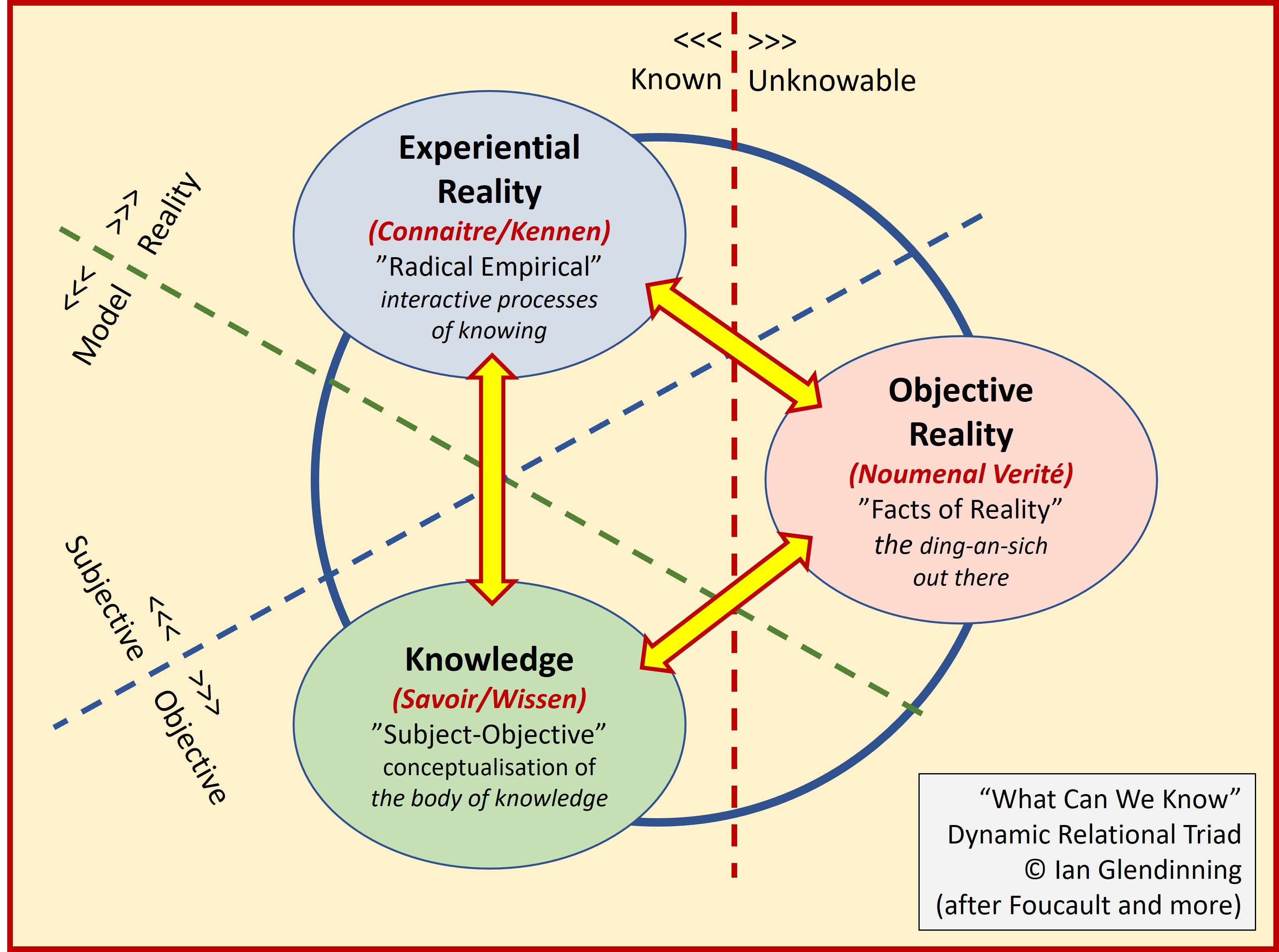
Nothing New Under The Sun. The above is as I said focussed on the more abstract concept of presenting a layered - epistemic-ontology - model. Thanks to Keith Gillette for the opportunity to get the previously drafted conceptual material organised. But what about the mappings / correspondences between the Pirsig layers and the other candidates?
Gillette’s Layering Correspondences & More
(Hold - captured / concluded in the RPA Discord Forum. Simplest summary from there with Keith Gillette and Paul Turner - (1) a 4-layer abstraction - any 2D layered view - is exactly that, too reductive to suggest it can “explain everything” in itself, without more detail on elements and processes within and between the layers - Obviously, my attempt for some particular socio-intellectual processes is in my diagram, and (2) Pirsig was not intending to bolt his MOQ ideas onto SOM ideas, but to replace the latter with the former, a pragmatic / radical-empirical, value-centred “valueism” - Less obviously and therefore in need of better presentation & explanation - my attempt to show the pinnacle as “MOQ-Intellect” in scare quotes, with SOMism as a historical element of the evolutionary process - this is the evolution of thought, not merely accretion. How does one “sell” a new idea, even an ancient new idea - to a wider population - without recognising its relation to the widely accepted status quo?)
=====
NOTES:
(*1) Static - Relatively static patterns, in that they change only over evolutionary timescales in those physical to mental layers, as opposed to changing with the dynamics of everyday activity. Like any species, patterns static long enough to be usefully recognised and named as such.
(*2) Dan Dennett - the evolutionary philosopher of consciousness.
Keith Gillette encountered Dennett on his book tour for “Darwin’s Dangerous Idea” in 1995. It was 2001 before I even considered that philosophy might be worth taking seriously when I first encountered Pirsig. During 2002/3/4 I had I noticed mentions and reviews of Dennett, his responding to AI Hype from Kurzweil, and the post-9/11 God vs Science wars, (where I could sense Dennett was a cut above, a dampener on, the rational scientistic zeal of, the other 3 horsemen philosophically).
It was 2005 before I read Dennett’s (2003) “Freedom Evolves”, (1991) “Consciousness Explained”, (1995) “Darwin’s Dangerous Idea”, (1981) “The Mind’s I” with Hofstadter, and Hofstadter’s (1979) “Gödel Esher Bach” and (1995) “Fluid Concepts and Creative Analogies”. Between then and his death I devoured pretty much everything Dennett did.
I summarised my readings of Dennett, with a focus on what I consider to be his magnum opus “From Bacteria to Bach and Back” (2017, B2BnB), when he died in 2024. I never actually read his (1996) “Kinds of Minds” but the evolved layers of Darwinian, Skinnerian, Popperian and Gregorian “creatures” which Gillette uses above are also aired in B2BnB. It was also the Dennett reference which Gillette mentioned and I responded to when we discovered our shared - autodidact fan-boy - interest in Dennett. Small world.
(*3) Cybernetics - self-governance of systems (of any kind) has been central to my whole research journey, even before I discovered metaphysical philosophy. It’s built into the name of my 26-year venture - Psybertron (Psybernetics in Psyberspace) - from the start, with the emphasis on the psyche levels of intelligent human agents in our electronically mediated information environment, to avoid any confusion with being too exclusively associated with physical feedback and control systems. I took my lead from Norbert Wiener’s original post-Macy “Cybernetics” (1946) where the term was expressly applicable to both animal and machine. Cybernetics too has been been through layers of evolution beyond that first and second pair and later phases in thinking. Complex Adaptive / Anthropic Systems Thinking or simply Systems Thinking in response to the most complex human socio-eco-system issues facing us. Although Systems Thinking has become ubiquitous in management and government, it is also subdivided into many overlapping methods and approaches, as many as there are management consultants and solution providers needing to brand their offerings. Choices and decisions between these are ultimately pragmatic. Two living sources who’ve maintained the significance of systems layering for me are Anatoly Levenchuk (different levels of abstraction in thinking about thinking, planning and doing) and John C Doyle (maintaining the separation of human hardware, operating systems and real-time operations).
(Incidentally, Cybernetics itself, like so many new technologies, even “siege engines” from which we engineers inherited the name for “applied ingenuity”, are developed in times of war. There’s always been military-industrial-complexes, since before the Romans. Radar in WWII, tracking enemy aircraft, needed control systems and communication loops to turn them into workable targeting systems. Nevertheless Wiener was thinking of the human animal and machines, in that order, when he coined “Cybernetics in 1946. A good BBC Edition of “In Our Time” on this and the community response from Peter Tuddenham. The term Cybernetics may have fallen out of use, but Systems Thinking is ubiquitous.)
(*4) Valentin (and Peter) Turchin. Valentin Turchin was a Russian cybernetician who made his original contributions to system dynamics in the 1960’s and 70’s. Together with Cliff Joslyn and Francis Heylighen (VuB in Belgium) he was responsible for creating Principia Cybernetica in the 1990’s and Joslyn and Heylighen were the hosts at VuB when Pirsig was invited to present “SODV” there in 1995. Son Peter Turchin has taken dynamic systems thinking - Cliodynamics - to the level of the history of civilisations and is to this day an active member of the Complex Systems Thinking community in which I find myself. (Incidentally, the Turchin’s fled Soviet Russia in 1977 so Valentin’s work became known in the west, unlike Aleksander Bogdanov another Cybernetics pioneer who a generation earlier had direct disagreements with Lenin, died in Russia, remained unknown in the west until after the fall of the Soviet Union and even wholly unreferenced by Turchin.)
(*5) Semantic Networks? - they’re natural and have been implicit in philosophical ontologies for millennia. The first person to coin “the semantic web” was Foucault in “Les Mots et les Choses” (1966), long before Tim Berners-Lee and the internet.
(*6) Hierarchies? - they’re essential and natural - inevitable - in taxonomic aspects of any ontology, and that is entirely separate from who gets to choose their significance or accidentally impose them on the politics of power hierarchies. Don’t throw baby out with the bathwater.
(*7) DSRP? - Distinctions, Systems, Relationships, and Perspectives by Derek Cabrera
=====