Intellectual-Social Interactions
Defining Pirsig's Social and Intellectual Layers

Preamble
This is a continuation of a dialogue happening in the Robert Pirsig Association (RPA) Forum Discord Server mentioned in this earlier post and effectively continued in this immediately previous Dennett-related post.
The starting point is that many thinkers have suggested evolutionary layering of the cosmos and our human understanding of it, so that’s neither unique nor contentious. The real question is in the value of the particular layers and relationships between them and in mapping their equivalence between the similar-but-different layering views posited. Any of these world-views held in mind when considering anything happening in the world are our deemed ontologies of the world and its workings, models that depend on our knowledge and understanding of Life, the Universe and Everything. The choice(s) of how to slice-and-dice our world-model is essentially pragmatic and inescapably metaphysical when choosing our first cut and arbitrary when describing the finite few layers to represent the upper-ontology of the gazillions of things we will want to represent and talk about in our world. Those previous two posts indicate the attraction of Pirsig’s Quality-based metaphysics (MoQ), sub-divided along static<>dynamic lines initially with just 4 physical / biological / social / intellectual layers of evolved static patterns.
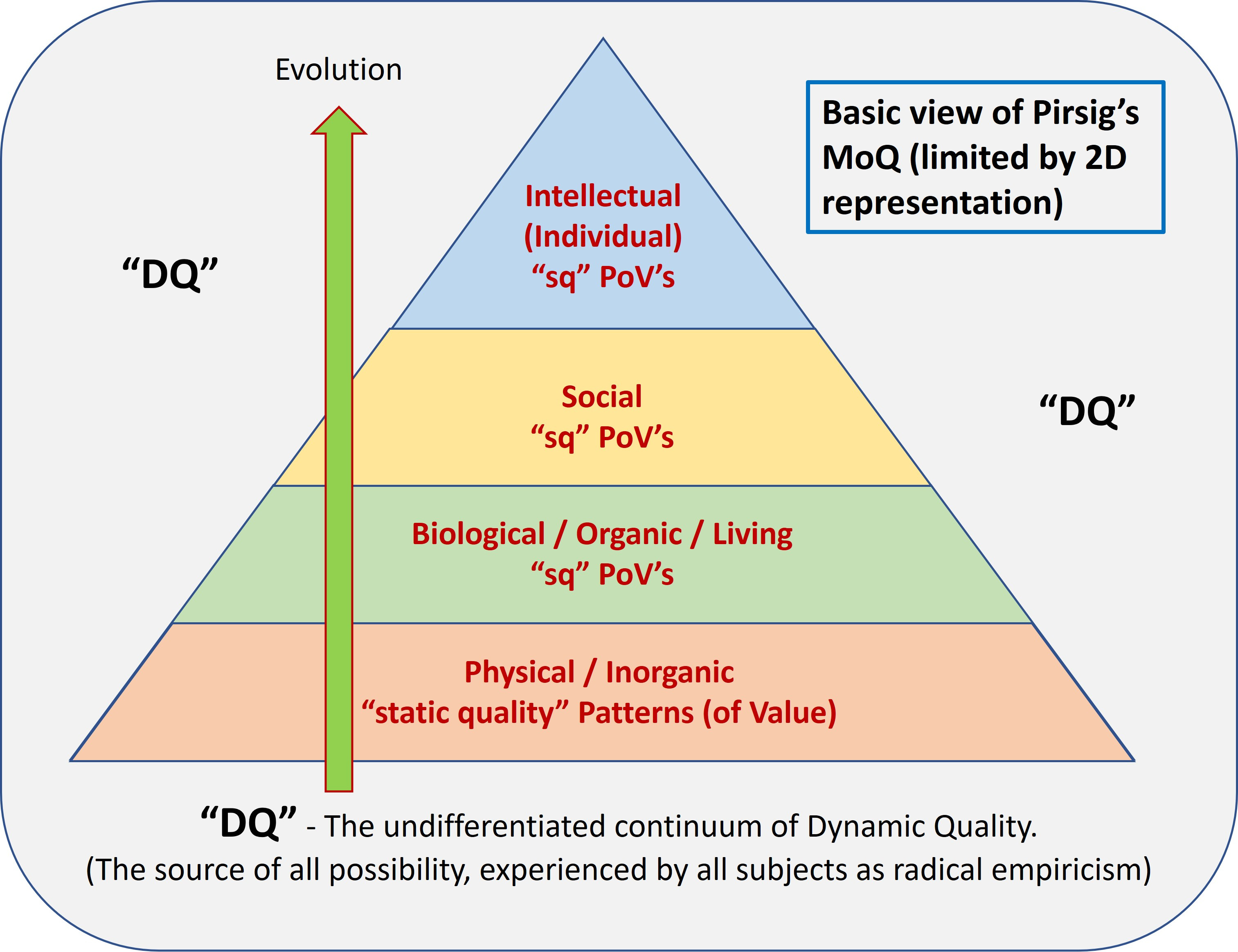
There’s agreement on the value of that model, and recognising the pragmatism in being able to map between alternative models without any beauty contest establishing any one as the absolute best or the most fundamental. However, working definitions of Pirsig’s social and intellectual layers have proven inadequate when applying them to complex real-world situations.
Besides myself and Keith (Gillette) there are Paul (Turner) and Brandon (Mayfield) in the dialogue, and Paul had just volunteered his definitions of those layers as discussed with Pirsig. This post is in response to that. Before following the detail, I’m getting the feeling that Keith’s early words already encapsulate the issue:
“We’re agreed that Pirsig’s four levels are far too reductive, though I find that they have value in being broadly orienting and useful as a fast heuristic.”
That’s very consistent with my expressed views of Pirsig’s MoQ as a “useful framework” on which to hang many other detailed considerations, and that definitions, broad or narrow, are “good fences” that shift and evolve with time and context and that it is “too reductive” to expect a single agreed distinction or definition to apply to every situation.
Working definitions of Pirsig’s Social and Intellectual MoQ Layers
Paul shared what he’d written in 2005, quoted in its entirety here with my responses (and references to others’ responses) inserted:
When defining any level in the MOQ I would argue that there are at least three aspects to consider. First is the defining value of the level, second are the observable relationships which structure the level, third is the process by which patterns are latched. I think some confusion has occurred by not considering all aspects. Here are my definitions of the social and intellectual levels with respect to all three aspects.
Yes “at least 3 aspects” and that choice of 3 is a good start. (3’s figure highly in my thinking already.)
I think the defining value of the social level is something like “eminence”, the level is structured by relationships between humans (mostly), and its primary latching mechanism is mimetic and emulative behaviour.
“Something like” eminence, sure. As Keith already responded there’s a narrow quality / excellence / virtue connotation to the word “eminence”, and Paul has already introduced “mimetics”, so Keith and I would probably agree on (Dawkins / Dennett) use of "memetics”. For me the (whole?) issue is precisely “the memetic problem” or #Dysmemics. ie it’s not about eminence in any “good / virtuous” quality sense - it’s more about social reach and influence - especially in our ubiquitous electronic mediated age. Absolutely fundamental to my own agenda, and the issue I have is that (what passes for) intellectual is itself massively distorted by this social effect - easily shared, simple messages, not necessarily true or good ones, win out and drown out better (harder, subtler) truths. So I will be interested in where Paul picks up the interaction with the intellectual layer.
What I have in mind is a process by which novel, non-genetically-hardwired behaviour exhibited within a species is able to be transmitted from one organism to another and sustained in a way which does not involve biological reproduction and can therefore outlive a single generation without any change to DNA (which is the biological latching mechanism). I think the simplest mechanism for this is imitation. We imitate and emulate those we see as having a quality which I have described as eminence which covers things such as authority, celebrity, status, leadership etc.
I think that this basic imitation and emulation can, over long periods of time, establish highly complex patterns of ritual, tradition and authority (and the institutions which embody them) which can impose a non-instinctive behaviour enabling the collective energy of groups of organisms to be harnessed for purposes greater than the immediate satisfaction of individual biological quality. I think the basic latching mechanism of mimesis also explains the dominance in culture, still, of more intellectually “trivial” things such as fashion and celebrity.
Absolutely, agreed. In short, social is defined by memetics. What makes ideas stick in culture and in individuals within a culture. Their “stickability” qualities not their truth / virtue qualities.
I see the pinnacle of the social level as the learned symbolic exchanges of arbitrary “marks and noises” that constitute language and the beliefs they encode.
Yes, but note it’s both the symbology and the content (beliefs) - easy to communicate and easy to (appear to) understand.
The defining value of the intellectual level is “truth”. The relationships which structure intellectual patterns around the central value of truth are those commonly described by the term “rationality”. Rationality enacts the assumption that a belief is true by virtue of its justificatory relationships with other beliefs. Where social level beliefs gain their quality from the relative eminence of the individual or organisation espousing them, or by fiat or divinity alone, the quality of a belief with an intellectual level component is attained by successful justification independently of who holds it.
My problem is that that is the theory of GOF SOMist “rationality” but what passes for intellect / rationality in a culture is largely memetic (social) anyway. We can do better?
The relationships which justify intellectual level beliefs are those defined in the rules of valid inference, algebra, geometric axioms and such like, which, although existent in various forms at earlier dates, seem to have been systematised in various places around the world for the first time somewhere between 4th Century BCE - 2nd Century and can be found in any decent rhetoric and mathematics textbook.
We can think of the intellectual level as consisting of vast web-like structures of inferential justification stretching back over time where the overall quality of such a structure, typically measured in terms of logical consistency, breadth and economy of explanation, largely determines the quality of a particular intellectual pattern in terms of how well it fits into it.
Again, theoretically yes, but practically in real-world (complex) situations social (memetic) considerations dominate. I’m looking for an “intellect” that covers not only GOF SOMist rationality, but redresses the social imbalance - a MoQish Intellect? Paul also acknowledges a pragmatic sense of truth intended in our “semantic web” not just some absolute “rational” logical / objective Truth. It’s why my Triad diagram wants to bring radical empirical truths into our more complete MoQish knowledge space? I think Brandon’s comment summarises both sides of this intellectual<>social balance “For example why should individual/human intellectual truth automatically have moral priority over social authority. I understand Pirsig’s historical argument that the intellectual level liberated humanity from oppressive social patterns, but “truth” itself is not a simple concept. Do we mean logical truth, scientific truth, pragmatic truth, or Truth as an aspect of reality itself? Many systems thinkers, including Pirsig, seem deeply suspicious of dogma, inherited authority, and religion, yet intellectual systems can become dogmatic as well.” As I say, intellect is not really independent of social considerations - so it’s the interactions between the two that matter most?
The process by which the latching of intellectual patterns is enabled is the skilled manipulation of abstract symbols according to the different types of rules referred to above. Just as DNA and the genetic code enable new biological structures to be superimposed on inorganically created chemicals, allowing a value of “life” to latch, flourish and oppose the perceived “death” of the inorganic level, logical and mathematical symbol manipulation enables new intellectual structures to be superimposed on socially created language and numbering systems, allowing a value of “truth” to latch, flourish and oppose the perceived “dogma” of the social level.
Yes, that intellectual “body of knowledge” (in my Triad diagram) uses abstract symbology manipulation, documented (latched) separately from social and inter-subjective behavioural and ritual process symbology. However, I think the key word in that last paragraph is “enable/s/d” - used 2 or 3 times? So, no argument that Paul’s summary represents (my/our existing understanding of) Pirsig’s social and intellectual layers - this is what’s possible and intended (should work in theory) but not a very complete description of how things really work or should work (in practice)?
As per Keith’s earlier comment - we probably shouldn’t expect a simple 2-layer model of (mostly) human knowledge - social and intellectual - to capture everything about their interactions. (Incidentally another reason for a more process focussed ontology?)
(I already have some updates and builds to my various figures that I’m hoping will capture some interpretation of this learning so far. Thanks folks.)
=====